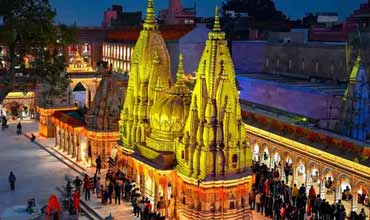
Ayodhya is a city located in Uttar Pradesh and nestled on the banks of the Saryu River, and is renowned as the Janmabhoomi (birthplace) of Shri Ram. The city is considered one of the Saptapuri (seven sacred cities) of Hinduism. Ayodhya holds a great spiritual as well as cultural influence, which is filled with the history of Shri Ram’s life. From the birth of Shri Ram to the 14-year exile and the return with Sita and Lakshman after defeating Ravana and achieving victory over Adharma. Witness the major sites of Ayodhya mentioned in the Valmiki Ramayana with the Ramayana tour package.
One of the most prestigious sites of Ayodhya is the Shri Ram Janmabhoomi temple. After a long legal dispute and several political conflicts in Ayodhya, the verdict of the Shri Ram Janmabhoomi temple has finally come out, and with grand celebrations, the mandir is finally open to devotees with a belief in faith and blessings.ngs. On the day of inauguration, the temple received a large number of footfalls.
History of the temple
Ayodhya is one of the oldest cities of the country; it is associated with the great Hindu epic Ramayana. The city has a vast history from a religious perspective, and the city has faced many conflicts due to the Babri Masjid and Ram Mandir dispute. The city is considered one of the Saptapuri (seven sacred cities) in India along with Mathura, Haridwar, Kashi, Kanchipuram, Ujjain, and Dwarka. Discover the birthplace of Shri Ram in the palace of King Dasharath with an Ayodhya tour package.
Ayodhya is home to the Sun dynasty (Suryavansha), to which Lord Ram himself belongs. The major history that Ayodhya holds is regarding the dispute between Hindus and Muslims, as during the era of the Mughals, the Mandir was demolished and replaced with Babri Masjid, which was the main reason for the dispute. As the sentiments of Hindus were hurt, they fought back for years for the establishment of Ram Mandir at the original birthplace of Lord Ram. After many years of cases and judgments, in 2019, the final verdict came, and the mandir began to be established. On 22nd January, 2024, the temple was inaugurated, and many devotees came to offer their prayers to the divine temple.
Architecture of the temple
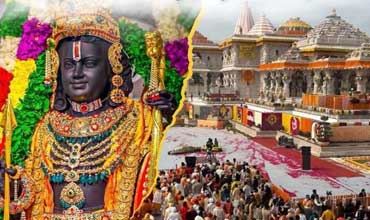
The temple is built in the Nagara style; many temples have already been constructed in this style, like the Sun Temple, Konark. It is built in both the north and south styles with the rules and regulations of VastuShastra. The temple is around 250ft long, 250ft wide, and 161ft high. The temple is three-storied and comprises 5 mandapas and a shikhara. The main deity of Shri Rama is in the infant form called Rama Lalla. The 5 mandapas are Nritya Mandapam, Rang Mandapam, Sabha Mandapam, Prarthana Mandapam, and Kirtan Mandapam.
The deity of lord Rama is around 51 inches high and depicted as a 5-year-old boy with a dark complexion and innocence on his face, holding a bow in his left hand and showing an abhaya mudra gesture of blessing and protection with his right hand.
Spiritual significance
Ayodhya, one of the most sacred places in India, is deeply infused in spirituality and has major significance in Hinduism, which depicts the connection of devotion and the devotees. The Hindu devotion shows the birth of Lord Rama, the 7th incarnation of Lord Vishnu. It is believed that the Lord Rama was born in Human for because Ravana did a lot of penance to receive a boon from Brahma, the creator that he cannot be killed by any God or demons but he didn’t ask for the protection from human beings and animals, this is the main reason of the birth of Lord Ram as human, to defeat Ravana. This gives birth to one of the two famous Hindu epic Ramayana. And Ayodhya is the city that depicts the journey of Shri Ram’s life.
The most devotional site of Ayodhya is the Ram Janmabhoomi temple. The temple is not as common as other Hindu pilgrimage sites; it is connected with the emotions of people who have waited for the judgment of the court and have always been a part of the journey. The temple has faced many conflicts, but later, as lord Rama won over Adharma, the temple remained unbreakable.
Why visit Ayodhya?
Ayodhya is not only a city; it is a symbol of faith and perseverance. This city depicts the story of the birth of Shri Ram and places related to his lifelong journey. The city will teach you the history of the Hindu epic Ramayana and the conflicts related to Ayodhya. You will get to know about the tales related to the Babri Masjid and the reconstruction of the temple. Witness the beauty of the Saryu River and enjoy the other sightseeing spots of the city. Witness the most famous vibrant festivals of Ayodhya by booking a Dharmik tour package and watch the different rituals that are performed during the festivals.
Places to visit in Ayodhya
Shri Ram Janmabhoomi Temple
It is the most divine temple in Ayodhya, the place where Lord Rama was born and spent many of the important events of his life. Visiting the temple will provide you with the visuals of the deity in his childhood phase as a 5-6 year old boy with innocence and a polite smile on his face. Offer prayers and seek blessings at the temple.
Hanuman Garhi
The temple is situated in the middle of the spiritual town that is formed in the shape of a fort. According to legend, lord Hanuman used to reside in the cave and protect the town. The temple has the golden idol of Lord Hanuman, which is believed to provide blessings and protection to the devotees. Hanuman Garhi receives a large number of devotees throughout the year.
Saryu Ghat
The SaryuGhat is one of the less commercial and most devotional sites in Ayodhya. It is believed that this Ghat has witnessed every phase of Shri Ram’s life and that every footfall of Lord Shri Ram has blessed this Ghat. You can sit here and experience the holiness of the town. Saryughat has been mentioned extensively in the ancient text Ramayana.
Kanak Bhawan
KanakBhawan is a temple located to the northeast of the Ram Janmabhoomi temple in Ramkot, Ayodhya. The temple defines the history and architecture of ancient times. It was a gift from Lord Ram’s stepmother Kaikei to Sita on the wedding of Ram and Sita, which is also known as SonekaGhar. The temple was the private palace of Lord Rama and Mata Sita. The main sanctum of the temple has the idols of Sitaji and Ram ji, which have been worshipped by the devotees for a long time.
Dasharath mahal
A mahal that was established by King Dasharath, father of Lord Ram, in Treta Yuga, where it is believed that King Dasharath used to live with his family and relatives. The palace is also known as BadaSthan or BadiSthan. At present, DashrathMahal has become a famous holy temple, where sits the idol of Lord Shri Ram, Mata Sita, Lakshmanji, Shatrughanji, and Bharat ji. The mahal is located a short distance from Ram Janmobhoomi.
Sita Ki Rasoi
SitakiRasoi is located in the north-west of the Ram Janmabhoomi temple, which is located in Ramkot, Ayodhya. It is believed that this was the kitchen originally used by Sita Mata. The kitchen is now a sacred site that exhibits vessels. The kitchen is in the basement, and the other side of the site has the idols of Ram, Laxman, Bharat, Shatrughan, and their wives. Mata Sita is also known as Goddess Annapurana. Therefore, the temple offers free food, and devotees also donate things or money to the temple.
Ram ki Paidi
The ancient steps on the banks of the Saryu River, known as Ram kiPaidi, which receives many footfalls, have been a sacred site of Ayodhya. Paidi means stairs, and Ram kiPaidi stands for Ram’s stairs. It is believed that taking a holy dip in the water of the Saryu River will wash away your sins and purify your soul. According to legends, Lord Ram used to bathe here during his lifelong journey.
Gulab Bari
Gulab Bari, "Garden of Roses," is a historic site located in Ayodhya. The monument is not known to many of the travellers. This location is filled with a variety of roses and beautiful architecture. Gulab Bari is the tomb belonging to NawabShuja-ud-Daula, the third Nawab of Awadh, which is a shadow of the Awadh style of architecture. The area consists of the tomb of the Nawab and his mother with a large dome. If you are seeking a nature-filled paradise away from a pilgrimage site, you can definitely visit there.
Nageshwarnath temple
Nageshwarnath temple was established by Kush, the son of Lord Rama. According to Folklore, Kush lost his armlet while bathing in the Saryu River, which was picked up by a Nag- Kanya who fell in love with him. As she was a devotee of Lord Shiva, Kush built this temple for her. The present temple was built by Naval Rai, the minister of Safdar Jung, in 1750.
Guptar Ghat
The GuptarGhat is situated on the banks of the Saryu River. This was the place where Lord Ram performed Jal Samadhi. Later, it was created by Darshan Singh in the early 19th century. The ghat is not that popular, but had left an impression of the history of Lord Ram. On popular festivals like Diwali, the ghat is decorated beautifully, which is admired by the devotees.
Temple timings
Ayodhya Temple Opening and Closing Timings
- Opening Time: 5:00 AM
- Closing Time: 10:00 PM
- Afternoon Break: 12:00 PM - 2:00 PM (Closed for Bhog Aarti)
Aarti timings
| Aarti | Timing |
| Mangala Aarti (Morning) | 5:30 AM |
| Shringar Aarti | 7:30 AM |
| Bhog Aarti (Noon Pooja) | 12:00 PM |
| Sandhya Aarti (Evening Aarti) | 7:00 PM |
| ShayanAarti (Night Pooja) | 9:30 PM |
How to reach Ayodhya
Ayodhya is a destination that is easily accessible and reachable; here are the ways through which you can reach Ayodhya.
By Air:
The nearest airport is the Maharishi Valmiki International Airport, Ayodhya, which is easily accessible from major cities. People also prefer nearby airports like Lucknow, Gorakhpur, Prayagraj, and Varanasi to reach Ayodhya.
By Train:
The nearest railway stations of Ayodhya are AyodhyaCantt and AyodhyaDham, which are well connected to almost all major cities. By Rail route, AyodhyaDham is 135 kms from Lucknow, 164 kms from Gorakhpur, 157 km from Prayagraj, and 191 kms from Varanasi.
By Road:
Ayodhya is easily reachable by road. Either you can reach by driving your own vehicle, or bus services are easily available from major cities like New Delhi, Lucknow, Varanasi, and Prayagraj.
Best time to Visit
October to March (winter)
Ayodhya is a divine city that receives devotees throughout the year; however, the best time to visit Ayodhya is from October to March. The oppressive summer heat and the pleasant weather make it easy and comfortable for visitors to visit the major sightseeing attractions of this place. The temperature ranges from around 8°C to 25°C during these months. This season includes the winter months and creates a favorable environment for tourists.
April to June (summer)
The summer months bring extreme heat; the temperature reaches around 43°C–46°C, and the air is dry and dusty. This season should be avoided due to the scorching heat; long queues could be physically exhausting. It is advised to avoid this season as it is not favorable for Elderly people, as the summer heat makes the health conditions worse, especially in open skies. Even if you are visiting during summer, always carry umbrellas, hats, sunscreen, and a water bottle to beat the heat.
July to September (Monsoon)
The season brings a beautiful landscape with lush green views. But the problem lies with the high humidity rate and the slippery Ghats, which lead to difficulties while you tour around the major sites of Ayodhya. Even though this season is the best season for bag packers as the prices of accommodation drop and the city is less crowded, which makes your darshan quick and easy as you don’t have to wait in long queues.
Major religious places to visit near Ayodhya
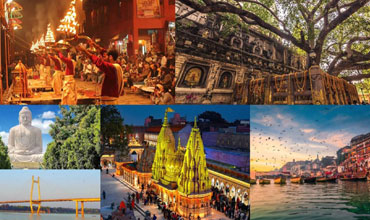
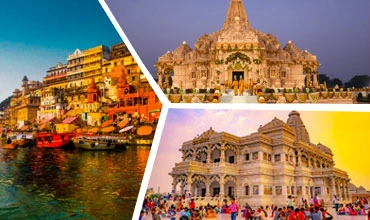
Varanasi
Varanasi is approx. 218km from Ayodhya with a drive of 4-5 hours. And can be easily reachable by direct train.
Places to visit in Varanasi
- Shri Kashi Vishwanath temple
- Assighat
- Dashashwamedh Ghat
Mathura/Vrindavan
The distance is approx. 540kms to 560kms which can be covered through train or drive of 8-9 hours.
Places to visit in Mathura/ Vrindavan
- Bankebiharimandir
- PremMandir
- Nidhivan
- Shri Krishna janmasthan temple
- Goverdhan hills
- Dwarkadheesh temple
Sarnath
Sarnath is approx. 220kms from Ayodhya which can be reached through driving or buses. It takes approx. 4-4.5 hours to reach.
Places to visit in Sarnath
- Dhamek Stupa
- Sarnath archeological site
- The Mahabhodhi society temple
Chitrakoot
This is the place where Lord Ram, Sita and Laxman stayed for 11 and half years of their 14 years of exile. The place is approx. 276 kms from Ayodhya.
Places to visit in Chitrakoot:
- Kamadgiri
- Gupt Godavari
- Ram ghat
Prayagraj
The distance between Ayodhya and Prayagraj is around 164 kms that takes around 4 hours to reach.
Places to visit in Prayagraj
- Triveni Sangam
- Khusro Bagh
- AnandBhawan
Vindhyanchal
Vindhyanchal is around 229kms from Ayodhya which is very close to Varanasi and is easily reachable.
Places to visit in Vindhyanchal
- Vindhyavasini Devi Temple
- Kali Khoh temple
- Sitakund
Major festivals of Ayodhya
Ayodhya, one of the holiest cities in India. The Janmabhoomi of Shri Ram is a spiritual destination with the most vibrant festival, which is celebrated with full joy and ancient traditions in Ayodhya.
Ram Navmi
Ram Navmi is celebrated on the auspicious occasion of the birth of Shri Ram. The entire town is lit up and beautifully decorated, along with the chants of mantras, bhajan, and kirtan. The festival is celebrated by worshipping the deity Shri Ram. Devotees gather together for the ShobhaYatra, a chariot procession in honor of the birth of Shri Ram.
Deepotsav/ Diwali
In Ayodhya, the festival of lights, Diwali, is celebrated in a different way, which is known as Deepotsav. The festival is organized by the Government of Uttar Pradesh, in which every corner of Ayodhya is lit up by Diyas every year in honour of the homecoming of Shri Ram along with Mata Sita, Laxman, and Hanuman ji. A laser and water show is also being played to depict the Ramayana with the bursting of firecrackers at Ram kiPaidi.
VivahPanchami
The festival takes place during the months of November or December, which marks the celebration of Lord Ram and Mata Sita’s wedding. The festival is celebrated by dressing the idols of Ram and Sita in wedding attire. Devotees perform rituals and sing wedding songs.
Dusshera
Unlike the other states of India, Dusshera is celebrated by an elaborate performance of Ramayan and showcases the symbolic defeat of Ravana by Lord Ram. One of the most celebrated festivals in Ayodhya is Dussehra, which is the true teaching of the ancient history related to the Hindu epic Ramayana.
Sita Navmi
SitaNavmi is celebrated to honor the birth of Sitaji, which is widely celebrated in Ayodhya. Devotees perform poojas and recite Ramcharitamanas. SitakiRasoi, the kitchen of Sitaji, who used to cook food there, has been given proper attention. Women gather in large numbers to seek blessings for peace, prosperity, and patience.
Shravan Jhula
The festival is taking place during the month of Shravana (July-august). The festival is celebrated mainly in KanakBhawan, the palace of Shri Ram and Sita, where the idols of Shri Ram and Sita is fully decorated is being placed on a jhula, which is beautifully decorated, and singing devotional songs. The locals and visitors came to pay their prayers.
Places to Shop in Ayodhya
| Places to Shop | Things to shop |
| Ram ki Paidi | Rudraksh beads, Tulsi Mala, Statue of Deities, prayer bells and Brass utensils. |
| Chowk Market | Fabrics, Handcrafted jewelry, traditional footwear and local handicrafts. |
| Ram Nagar Market | Sarees, Dupattas, kurta woven and decorative items related to Ramayana. |
| Saryu Ghat Market | Religious souvenirs, flower Garlands, incense sticks and devotional books. |
Travel tips
- If you are visiting Ayodhya, which is one of the most divine places in India, you need to follow some rules and regulations made for every devotee with respect to the culture and traditional values.
- Dress modestly while visiting the temple; your knees and shoulders should be covered. Avoid wearing sleeveless dresses above the knees for both males and females.
- Phone, cameras, smart watches, and power banks are prohibited on temple premises.
- Temples like Hanuman Garhi and Kanak Bhawan allow photography, but in the outer zone, photography near the deity is considered discouraged.
- Avoid carrying large bags as you have to keep them in the locker, which requires being in a queue. Instead, carry a small bag with only the required documents.
- Do not carry sharp objects like pocket knives, nail cutters, or scissors inside the temple.
- Always wear slip-on footwear, as it is easy to remove and easy to wear around the temple premises.
- Be a little patient and follow the queue, without rushing and panicking.
Conclusion
Ayodhya is a city filled with ancient history and tradition. There are many tales regarding Ayodhya that are related to the Ramayana. The most important site in Ayodhya is the Ram Janmabhoomi temple, which was rebuilt after many disputes. The city itself is an image of spirituality. By booking an Ayodhya tour package , one can witness the holiness of the city. Major sites like Dasharath Palace, where King Dasharath, father of Shri Ram, along with his family used to live, KanakBhawan, known as SonekaGhar, a gift of Mata Sita on her wedding with Lord Ram from his stepmother Kaikey, and many other places which are related to the Ramayana, the Hindu epic.
Experience the major festivals like Deepostav, Ram Navmi that are celebrated on a large scale in Ayodhya with great celebration. A trip to Ayodhya will teach you a lot about the ancient and spiritual history of this city.