
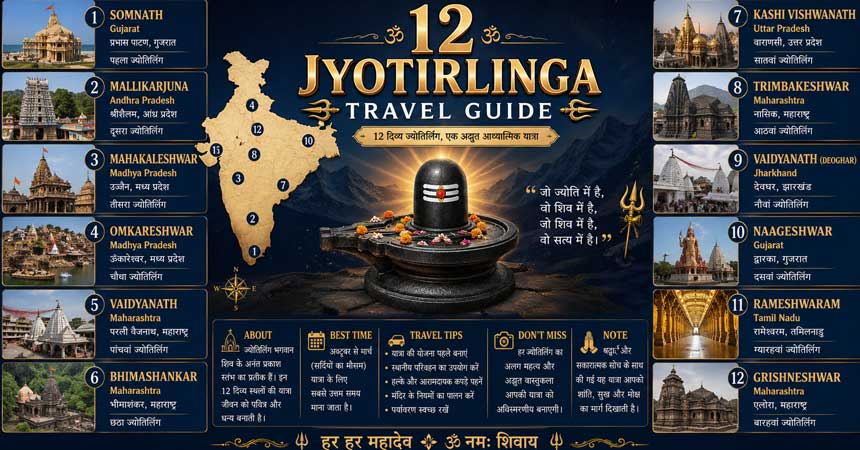
India is a land where spirituality and timeless devotion meet. The sacred Jyotirlingas of Lord Shiva beautifully capture this essence. Each of these 12 shrines are spread across India, and carry a unique tale, energy, and spiritual importance. If you want to have an impressive pilgrimage tour, exploring Jyotirlingas tour packages is one of the best options available.
If you want to travel to the Jyotirlingas reading this blog answers all your questions – from what makes these temples so special to a complete 12 Jyotirlingas tour package itinerary, later you’ll see that this blog includes a fully structured table for easy planning.
Table of Contents
What Are Jyotirlingas and Why Are They So Important?
The term “Jyotirlinga” comes from two Sanskrit words—Jyoti, meaning light, and Linga, representing Lord Shiva. These 12 places are dedicated to Lord Shiva, where Lord Shiva manifested himself as a radiant pillar of light, making them divine.
Some of these Jyotirlingas are regarded as “Swayambhu,” which means that these lingams appeared by themselves rather than being made by humans.
Each and every Jyotirlinga is to be believed as an energy center to help devotees achieve liberation (meaning moksha). Visiting all 12 is considered a deeply transformative journey and is dreamed by many. Jyotirlingas are believed to diffuse immense spiritual energy. Devotees believe that if you visit these shrines, it helps to purify the soul and remove past karmic burdens.
Each Jyotirlinga has its own mythological tale and its own spiritual importance. This is why millions of devotees aspire to visit all 12 in their life.
Where Are the 12 Jyotirlingas Located Across India?
The 12 Jyotirlingas are located across different states, making the journey both spiritual and geographically difficult. Here is the location for each Jyotirlinga:
- Somnath Temple – Gujarat
- Nageshwar Temple – Gujarat
- Kedarnath Temple – Uttarakhand
- Mallikarjuna Temple – Andhra Pradesh
- Mahakaleshwar Temple – Madhya Pradesh
- Omkareshwar Temple – Madhya Pradesh
- Trimbakeshwar Temple—Maharashtra
- Bhimashankar Temple – Maharashtra
- Grishneshwar Temple – Maharashtra
- Baidyanath Temple – Jharkhand
- Kashi Vishwanath Temple – Uttar Pradesh
- Ramanathaswamy Temple – Tamil Nadu
This geographically rich distribution makes better planning important—which is where Jyotirlinga’s tour packages become very useful.
Why Should You Choose Jyotirlingas Tour Packages Rather Than Planning by Yourself?
Planning and executing a trip to all 12 Jyotirlingas could be difficult as they are geographically spread in different parts of India. That’s where our Jyotirlingas tour packages come in handy. This tour package provides you with traveling experts, pre-arranged transportation, hotels, and darshan, which will save you time and avoid last-minute hassles and ensure a structured and comfortable experience for families and seniors.
By choosing a tour package,, you get the benefit of:
- They provide pre-planned routes for efficiency—A tour package ensures the most efficient and logical path between the 12 different sites, which makes the travel time less.
- They give housing and transport arrangements– If you try to manage travel, living space, and food across different states, it is very much difficult. Packages handle these things, which allow you to focus on your journey.
- Helps in guided temple visits—A tour package includes support for faster darshan (viewing) of the deities, and you can get help from experienced guides and 24/7 support.
- They know time-saving travelling routes—A tour package provides experienced agents who know the best routes, the best times to visit, and the best locations to stop.
- They provide better cost opportunity- tour packages provide tour operators who can secure lower rates for hotels and transport through bulk bookings, which makes it cheaper.
- There is comfort and safety, specially for old travelers—tour packages come with a pre-booked itinerary that ensures safe transportation and a less tiring journey.
If you’re aiming to complete all 12 temples comfortably, a structured 12 jyotirlinga tour package itinerary is your best option.
How Many Days Do You Need for a Complete Jyotirlinga Tour?
A full journey to the temples typically takes around 20 to 30 days, which depends on the travelling mode and stops. Some fast-track packages complete it in 15–18 days using flights, while the road-based routes usually take longer.
Different Tour Duration Options:
Rapid Trip option: 11–12 days (usually involves flights).
Best trip option: 15–18 days (allows time for darshan and travel).
In-depth trip option: 20–24 days (slow speed, suitable for old travelers).
Commonly Structured Itinerary:
- Gujarat & Maharashtra (4-5 days): Somnath, Nageshwar, Trimbakeshwar, Bhimashankar, Grishneshwar.
- Madhya Pradesh (2-3 days): Mahakaleshwar, Omkareshwar.
- North & East (2-3 days): Kashi Vishwanath, Baidyanath.
- South (2-3 days): Mallikarjuna, Rameshwaram.
- Himalayas (3-4 days): Kedarnath (seasonal access).
A Complete 12 Jyotirlinga Route Map & Distance Chart
| Day | Route Leg | Jyotirlinga / Highlight | Distance (kms) | Night Stay |
| Day 1 | Your place → Somnath | Somnath (Gujarat) | — | Somnath |
| Day 2 | Somnath → Dwarka | Nageshwar Jyotirlinga | 230 km | Dwarka |
| Day 3 | Dwarka → Rajkot / Ahmedabad | Travel buffer | 450 km | Ahmedabad |
| Day 4 | Ahmedabad → Indore | Transit to MP | 400 km | Indore |
| Day 5 | Indore → Ujjain → Indore | Mahakaleshwar Jyotirlinga | 60 km | Indore |
| Day 6 | Indore → Omkareshwar → Indore | Omkareshwar Jyotirlinga | 80 km | Indore |
| Day 7 | Indore → Nashik | Transit to Maharashtra | 400 km | Nashik |
| Day 8 | Nashik | Trimbakeshwar Jyotirlinga | 30 km | Nashik |
| Day 9 | Nashik → Pune | Transit | 210 km | Pune |
| Day 10 | Pune → Bhimashankar → Pune | Bhimashankar Jyotirlinga | 110 km | Pune |
| Day 11 | Pune → Aurangabad | Transit | 240 km | Aurangabad |
| Day 12 | Aurangabad → Grishneshwar | Grishneshwar Jyotirlinga | 30 km | Aurangabad |
| Day 13 | Aurangabad → Hyderabad | Transit | 560 km | Hyderabad |
| Day 14 | Hyderabad → Srisailam | Mallikarjuna Jyotirlinga | 215 km | Srisailam |
| Day 15 | Srisailam → Chennai / Madurai | Transit South | 600 km | Madurai |
| Day 16 | Madurai → Rameshwaram | Ramanathaswamy Jyotirlinga | 170 km | Rameshwaram |
| Day 17 | Rameshwaram → Varanasi (Flight/Train) | Long transfer | 2,364 km | Varanasi |
| Day 18 | Varanasi | Kashi Vishwanath Jyotirlinga | Local | Varanasi |
| Day 19 | Varanasi → Deoghar | Baidyanath Jyotirlinga | 420 km | Deoghar |
| Day 20 | Deoghar → Haridwar | Transit North | 1100 km | Haridwar |
| Day 21 | Haridwar → Kedarnath Base (Guptkashi) | Start Himalayan route | 220 km | Guptkashi |
| Day 22 | Kedarnath Trek | Kedarnath Jyotirlinga | 16 km trek | Kedarnath |
| Day 23 | Return Kedarnath → Guptkashi | Trek back | — | Guptkashi |
| Day 24 | Guptkashi → Haridwar/Delhi (then to you cities) | Tour Ends | 220 km | Departure |
Route Map Flow (Easy Understanding)
West India → Central India → Maharashtra → South India → East India → North India
What Is the Ideal 12 Jyotirlinga Tour Package Itinerary?
Here’s a well-organized itinerary covering all 12 Jyotirlingas in a route:
| Day | Destination | Jyotirlinga | Key Highlights |
| Day 1–2 | Gujarat | Somnath Temple | Coastal temple, evening aarti |
| Day 3 | Dwarka | Nageshwar Temple | Near Dwarka, beautiful location |
| Day 4–5 | Maharashtra | Bhimashankar Temple | Scenic forest surroundings |
| Day 6 | Nashik | Trimbakeshwar Temple | Source of Godavari River |
| Day 7–8 | Aurangabad | Grishneshwar Temple | Near Ellora Caves |
| Day 9–10 | Ujjain | Mahakaleshwar Temple | Famous Bhasma Aarti |
| Day 11 | Omkareshwar | Omkareshwar Temple | Island temple in Narmada River |
| Day 12–14 | Uttarakhand | Kedarnath Temple | Himalayan pilgrimage |
| Day 15–16 | Varanasi | Kashi Vishwanath Temple | Spiritual heart of India |
| Day 17 | Deoghar | Baidyanath Temple | Healing significance |
| Day 18–19 | Srisailam | Mallikarjuna Temple | Hilltop temple |
| Day 20–22 | Rameswaram | Ramanathaswamy Temple | Sacred sea rituals |
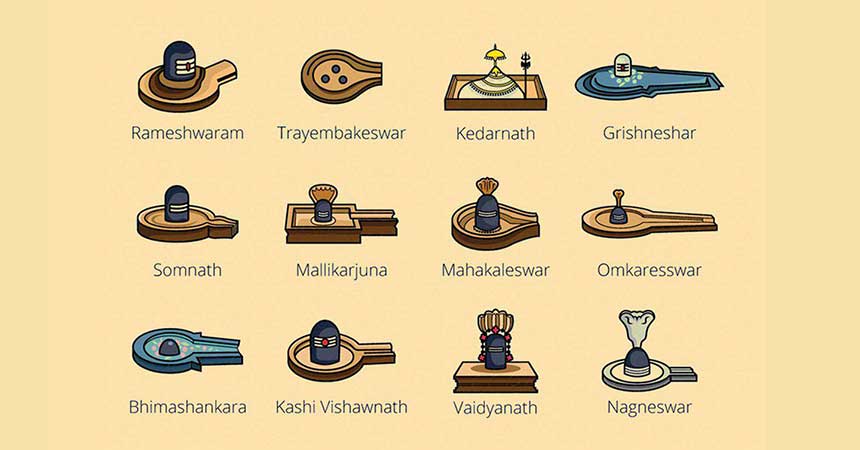
What Can You Expect at Each Jyotirlinga Destination?
Every Jyotirlinga offers a different spiritual experience:
- Somnath: It is the first Jyotirlinga, which depicts never-ending faith.
- Mallikarjuna: It combines the presence of Shiv and Shakti. It is known as the “Kailash of South”.
- Mahakaleshwar: It is the only south-facing Jyotirlinga, and this Jyotirlinga is considered as the master of time and death.
- Omkareshwar: The island on which this Jyotirlinga is present is unique because the natural shape of the island is like the sacred “Om” symbol.
- Kedarnath: It is one of the highest temples in India and features a unique, triangular, natural rock-formed lingam which represents Shiva’s hump.
- Bhimashankar: It offers amazing architecture, and it serves as the origin of the Bhima River.
- Kashi Vishwanath: It is the spiritual capital of India, and visiting this Jyotirlinga grants Moksha (liberation).
- Trimbakeshwar: It is associated with sacred rituals, and its lingam has 3 faces, which represent Tridev- Lord Brahma, Lord Vishnu, and Lord Shiva (trinity).
- Baidyanath: It is regarded as a place for healing and peace, where devotees gather to seek blessings for health and spiritual well-being for themselves and their loved ones
- Nageshwar: It is known as the symbol of protection. It is believed that if a devotee worships here, it frees the devotees from all poisons and external threats.
- Rameswaram: It is said that Lord Rama established this lingam to worship Shiva, and this site features two lingams: one was brought by Lord Hanuman (Vishwalinga) and one made of sand by Devi Sita (Ramalinga).
- Grishneshwar: It is known as the smallest Jyotirlinga in India, located near the Ellora Caves, a UNESCO World Heritage Site.
What are the places you need to visit around each Jyotirlinga?
Somnath:
- Triveni Sangam (Hiran, Kapila, and Saraswati rivers meet the Arabian Sea)
- Somnath Beach (for sunset views)
- Prabhas Patan Museum
- Bhalka Tirth
Mallikarjuna:
- Bhramaramba Devi Temple
- Paladhara Panchadhara (place with waterfalls and streams)
- Akkamahadevi Caves
- Sakshi Ganapati Temple
Mahakaleshwar:
- Kal Bhairav Temple
- Sandipani Ashram
- Kaliadeh Palace
Omkareshwar:
- Mamleshwar Temple
- Gauri Somnath Temple
- Siddhanath Temple
Kedarnath:
- Gaurikund (hot springs)
- Bhairav Nath Temple (guardian deity)
- Vasuki Tal (high-altitude lake)
- Triyuginarayan Temple
- Chopta (mini Switzerland)
Bhimashankar:
- Bhimashankar Wildlife Sanctuary (home to the giant squirrel)
- Hanuman Lake
- Gupt Bhimashankar temple
Kashi Vishwanath:
- Dashashwamedh Ghat (for evening Aarti)
- Manikarnika Ghat (historic cremation site)
- Vishwanath Gali (shopping hub)
Trimbakeshwar:
- Kushavart Kund
- Brahmagiri Hills (source of the Godavari)
- Anjaneri Hills (birthplace of Hanuman)
Baidyanath:
- Trikut Hill
- Naulakha Temple
- Satsang Ashram
Nageshwar:
- Gopi Talav (a lake with yellow clay)
- Rukmini Devi Temple
- Bet Dwarka
Rameswaram:
- Dhanushkodi (India’s ghost town)
- Pamban Bridge
- Kothandaramaswamy Temple
Grishneshwar
- Ellora Caves (UNESCO World Heritage site, which features the monolithic Kailasa Temple)
- Bhadra Maruti Temple (sleeping Hanuman idol)
- Daulatabad Fort
What Is the Best Time to Plan a Jyotirlinga Tour?
The ideal time is October to March, when the weather is pleasant across most regions.
Avoid-
- Peak summer (April–June)
- Monsoon season (July–September), especially for Kedarnath
Factors to keep in mind-
- Favourable time- Shravan month (July-August) is highly significant, but the Jyotirliongas are extremely crowded.
- Duration- A 15- 20 day itinerary is best to cover all the Jyotirlingas efficiently.
- Seasonal openings- Maharashtra and Gujarat Jyotirlingas (Somnath and Bhimashankar) are best in winter (October – March). Kedarnath is only open between May and October/ November.
- Festivals- Mahashivratri is a very popular time for the tour, but the people would be in high numbers.
- Tour tips- Going with pre-planned packages can provide a smoother experience.
How Much Does a 12 Jyotirlinga Tour Package Cost?
The cost varies depending on travel style:
- Budget packages: ₹40,000 – ₹70,000
- Mid-range packages: ₹70,000 – ₹1,20,000
- Luxury packages: ₹1,50,000+
Factors affecting price:
- Mode of Transportation: The tours with air-conditioned flights are significantly more expensive than those using trains or buses.
- Duration: The complete 12 Jyotirlinga circuit is long. If the itineraries are longer, especially those including helicopter travel to Kedarnath, the cost increases.
- Accommodation Type: If you stay in 3-star, 4-star, or luxury hotels, the trip budget will increase, but if you stay in budget hotels or dharamshalas, the prices can be very low.
- Travel Season: Travelling during peak seasons (e.g., Mahashivratri, summer holidays, or Shravan Month) increases accommodation and travel costs.
- Inclusions & Exclusions: If you choose packages covering meals (vegetarian), transfers, guided tours, and special Darshan, the charges are higher priced, but they offer better value for money.
What Are the Travel Tips for a Smooth Jyotirlinga Journey?
- Book early during peak seasons – Booking hotels and transport beforehand is great, especially for popular sites like Somnath, Varanasi, and Ujjain.
- Best Time to Visit: Plan the trip from October to March for pleasant weather across India and avoid monsoons (July–August)
- Carry comfortable and appropriate clothing and footwear: Wear traditional/modest attire, kurtas/ dhotis for males and sarees/kurtis for females.
- Keep your IDs: Carry a genuine government-issued identity card (such as the Aadhaar Card, PAN Card, Passport, or Voter ID).
- Better scheduling: Start your day early (4-6 AM) for a faster and a better darshan, this will help you to avoid long waiting queues.
- Health & Safety: Stay hydrated, as it is a long journey, and carry a first-aid kit. Also prepare for a high altitude journey.
Is going to 12 Jyotirlingas worthwhile?
Absolutely 100%. This 12 Jyotirlinga tour is not just about visiting these temples, it’s about having a spiritually fulfilling journey. This journey is all about experiencing devotion, discipline, and finding inner peace.
Each Jyotirlinga’s destination adds a new dimension to your spiritual knowledge.
Conclusion –
If you think that going on a 12 Jyotirlinga tour is just another pilgrimage, you are wrong. It’s a memorable experience that mixes devotion, travel, and self-discovery. With well-organized Jyotirlingas tour packages, completing this sacred circuit becomes available and comfortable for everyone.
In this journey, whether you seek blessings, peace of mind, or a deeper connection with Lord Shiva, following a well-structured 12 jyotirlinga tour package itinerary will make this divine journey unforgettable.
So, the real question is—when are you planning your Jyotirlinga yatra?
Frequently Asked Questions (FAQs)
Jyotirlingas are temples dedicated to Lord Shiva where he is believed to be present as a divine pillar of light.
They are considered powerful spiritual centers that help devotees attain peace, cleanse karma, and move toward liberation (moksha).
There are a total of 12 Jyotirlingas located across different states of India.
The best way is by choosing well-planned Jyotirlingas tour packages for a smooth and organized journey.
A complete Jyotirlinga tour usually takes around 15 to 30 days, which depends on the travel plan.
The ideal time to visit is from October to March.
Yes, these packages are designed to provide comfort, safety, and ease for all age groups.
The cost generally ranges from ₹40,000 to ₹1,50,000 or more.
Yes, Kedarnath is included in the 12 Jyotirlingas tour itinerary, but it requires a trek and is seasonally accessible.
Yes, it is a deeply spiritual and life-changing journey that offers devotion, peace, and self-discovery.